Documenters: Tallmadge City Schools Board of Education meeting for Dec. 17, 2025
By Bethany Ulrick
Tallmadge City Schools Board of Education regular meeting
Dec. 17, 2025
6 p.m.
Tallmadge High School
140 N. Munroe Rd.
Tallmadge, OH 44278
Attendance: Board President Mark Fairhurst; Vice President Mike Passarelli; board members Todd Loughry, Jennifer Ross, Chad Davis and Kim Polatas; Superintendent Steve Wood; Treasurer Jeff Hostetler; and Director of Student Services and Data Analytics Roy Zeman
Summary
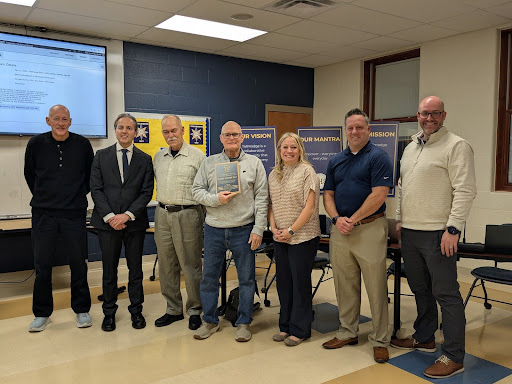
This was the last meeting for Board President Mark Fairhurst, who retired after 12 years serving on the board. He was presented a plaque as a token of appreciation for his leadership and contributions to the district.
The board passed a resolution to request information from the state tax commissioner’s office about what numbers they would need to put on a levy for the May 2026 ballot in order to generate $3.7 million. Treasurer Jeff Hostetler explained that this deficit is caused by the state of Ohio reducing the amount of funding Tallmadge City Schools receives, not the district’s spending. Hostetler said that when property values were appraised and went up, the district actually began receiving less funding because the state determined it was now wealthier and needed less money. He went on to explain the different kinds of levies available, and that the district will likely proceed with an earned income tax levy, which would not tax retired seniors who are on a fixed income.
Hostetler also explained that the district has already cut nine staff positions, but will need to cut more, even if the levy does pass. If the levy fails, the district would have to go to state minimum bussing, which means high school students would no longer be able to ride the bus to school and the elementary and middle school bus routes would only cover a two-mile radius from each building.
There will be additional information released in the future providing more information about how the state budget has reduced Tallmadge City Schools’ revenue and a detailed explanation of what cuts would be made if the second levy attempt does not pass in May.
The first reading of the 2026-2027 academic calendar was approved, and the calendar will soon be available online for residents to look over and submit comments for 30 days. The calendar will be voted on again and approved if there are no concerns at the January board meeting.
The board and administrators said that while they are disappointed that their schools were the victim of a hoax threat on Dec. 16, they are proud of the orderly response of the staff and students in each building and the rapid response of law enforcement from Tallmadge and the neighboring communities.
Documenter's Notes
A motion was passed to approve the previous meeting minutes.
Superintendent Steve Wood thanked retiring Board President Mark Fairhurst for his 12 years of service to the district and his contributions during building projects, levies and superintendent changes.
Fairhurst said he couldn't pick a favorite moment of his time on the board, but the most fun part was the Distinguished Scholars Breakfast. He enjoyed seeing a banquet room full of so many high-achieving students who were involved in so many extracurricular programs and seeing many proud parents and grandparents attend. Fairhurst was presented a plaque for his tenure on the Board of Education.
Recommendations of the Board of Education
In November, the district put a levy on the ballot that did not pass. Fairhurst thanked those who volunteered for the campaign and everyone who voted both for and against the levy. He said that the community opposition has shown the board that there needs to be more transparency when explaining the financial situation and they intend to provide more information.
Fairhurst said that there is a current and future decline in state funding, which will decrease from 40% of the district’s budget to 27% of the district’s budget in the next fiscal year.
Treasurer Jeff Hostetler explained that to put an earned income levy on the ballot, Tallmadge City Schools must pass two separate resolutions. First, the board must pass a resolution of necessity, which allows them to send a request to the state tax commissioner to ask what specific percentages a levy should have to generate the amount of revenue the school needs to generate the $3.7 million in funding lost from the state.
This resolution was passed unanimously at the meeting. It only authorizes a request for information; the school district can decide in January what kind of levy to put on the ballot.
After receiving information from the state about the numbers and tax rates needed to generate $3.7 million, another resolution must be passed to set the tax rate and the length of the levy, and those details must be submitted to the county board of elections 90 days before the election.
He emphasized that this gap in funding is only due to the state government reducing its share of funding, not a result of any spending by the district. He explained that Tallmadge property taxes went up significantly during reappraisal, causing effective millage to decrease and the state to determine that the district was wealthier and required less funding from the state budget. Another issue he cited is that the formula the state uses to calculate a school’s costs has not changed in four years, despite costs of goods and services rising significantly in that time. There are plans to create and release videos to help the public better understand the budget deficit.
Hostetler said that the district put an income tax levy on the ballot over 10 years ago that failed and has not tried since. However, he said other districts are also looking into income taxes, given the negative public sentiment toward property taxes and the possibility of voters having the option to abolish property taxes on the ballot in November of 2026. Tallmadge City Schools would likely pursue an earned income tax instead of a levy that taxes all income.
Wood explained that, even if the district puts a levy on the ballot in May 2026 and it passes, cuts will continue to be made because there will still be a deficit, and the community is in favor of cutting costs. Nine positions were eliminated last year, and the administration is currently looking at further reducing staff. There will be some cuts to bussing if the levy passes; however, if the levy fails, Wood said that the district would have to go to state minimum bussing. This would eliminate bussing for high school students and reduce the elementary and middle school bus routes to only cover within two miles of either school. Wood acknowledged that this would be devastating for many families. He added that Tallmadge City Schools already is within the lowest three for spending per pupil in Summit County, but regardless of the levy passing or failing, the district will continue to lower that number while trying to avoid taking funding from areas that negatively impact the classroom experience.
In January, the board will release a detailed cost reduction plan to the community on social media, and residents may also request a copy by contacting the district. This document will explain what areas would see cuts if the levy fails.
Hostetler and Board Member Chad Davis added that they both, among others from the district, have been contacting state officials to express their concerns about the budget and bills that would reduce revenue. They received confirmation that their messages were delivered but stated that they do not feel their testimonies had any impact.
Davis added that he is already seeing opposition to the earned income tax, but Tallmadge City Schools believes this is the more reasonable option because, unlike property taxes, an earned income tax would not affect seniors who are on a fixed income. He said that over 200 schools in the state of Ohio have income tax levies. Norton is the only other district in Summit County that does, but he believes Tallmadge will be one of the first districts of many to use earned income taxes.
An earned income tax was attempted and failed in 2007, but Davis said the situation back then was different, and that there is a real possibility all revenue from property taxes is lost if they are abolished next year.
Vice President Mike Passarelli said that he has heard some members of the community would support an earned income tax, but that he has heard from some city government officials that they would prefer to see the district put another property tax levy on the ballot. He said that he does not believe a second property tax levy would be passed because the community has made it clear that they do not want one.
Davis explained that the average household income in the district is around $100,000, meaning that an earned income tax would cost a family bringing in that combined salary about $750 per year, whereas a property tax would have cost them $440, but would burden seniors. He said he understands that nobody wants to pay more in taxes, but that the earned income tax is the lesser of two evils and their options are limited. It was also clarified that this income tax would only apply to people who reside within the school district, not those who work in the jurisdiction but live elsewhere.
The board appointed Passarelli to serve as the president pro tempore until a new president is formally elected at the organizational meeting, where other officers will also be appointed. The meeting date was set for Jan. 8, 2026, from 10-11 a.m. at the MEC, and it will be open to the public.
Recommendations of the Treasurer
The board unanimously voted yes to accept the financial reports for the month of November. Hostetler explained that purchased services were high because of some catching up payments, but nothing unexpected. In February, the district will need to update the financial forecast to send to the state. This will be discussed in more detail in January.
The board approved the first reading of the 2026-2027 school calendar, which will be posted online and be available for public review and comment for 30 days before it is voted on at the January board of education meeting. The 2027-2028 calendar is also being worked on and the district hopes to have it available for the public in the spring of 2026.
Personnel Items
The personnel hirings and resignations were unanimously accepted by the board.
Resignations include a para, an intervention specialist and Jeff Swindell, who worked with in-school suspension/APEX students. Swindell was known for his passion for helping kids find careers that fit them. All of these positions have been filled.
It was explained that the special education caseload has increased, as it usually does around this time of year, because this is the time when new students who need additional accommodations are identified.
Fairhurst asked how the board can communicate this need to the community given the budget deficit. Director of Student Services Roy Zeman explained that the student per special education professional ratio is approaching the legal maximum, so a recommendation will be made to hire another intervention specialist as is required by Ohio law. He added that special education is funded by a combination of state and federal dollars, because money for 504 plans comes from the federal government. When more students begin receiving additional support through 504 plans, the schools receive more money, though it is not enough to fully cover the cost of hiring another intervention specialist.
Central Office Report
Wood spoke about the “good stuff” of the past month. He first highlighted the success of the band and choir programs, noting that in the future there will be a need to find larger spaces for their concerts because so many people have been attending them, and they may eventually run out of room.
He reported that wheelchair basketball, swimming and wrestling seasons are off to a good start. Students had a game day on Dec. 12 where they were able to broadcast a sports show before the game.
The annual Thanksgiving meal at Tallmadge High School was a success. Wood also said that he has seen a lot of people putting effort into silly or elaborate festive outfits for the holidays, which he believes is improving student morale, especially as they are preparing for and taking their end of the semester exams.
Wood said that students are participating in the Team Tressel Fitness Challenge. Lieutenant Governor Jim Tressel made a visit to the elementary school in November and afterwards said that he was impressed with the district and grateful to have been invited to come.
The board and administrators commented that while they are disappointed that the district had a hoax swatting attack on Dec. 16, they did appreciate the calm and efficient response from students, staff and local law enforcement. Parents had also given feedback that they were grateful for the frequent and transparent updates on the situation they received from the schools.
Wood expressed his condolences to the family of senior Logan Leighty, who passed away. He had been in Tallmadge City Schools since 4th grade and had been doing very well in the career tech program after being placed at Laurel Lake, where he worked with the maintenance team and had made a difference in the lives of the seniors that live there. Laurel Lake held a memorial service for Leighty, where they talked about how much the staff loved having him around.
Public Comment
Second grade teacher and Teachers Association President Rebecca Miller congratulated Wood on receiving the Administrator of the Year Award from the Ohio Association for Health, Physical Education, Recreation, and Dance and Matt Hagedorn for receiving the Health Education Teacher of the Year by SHAPE America. She added that 48 middle school students went shopping with officers through the Shop with a Cop program.
The meeting was adjourned.
Post a reply