Documenters: Hudson City Council meeting for Oct. 6, 2026
By Julie Erickson
Hudson City Council meeting
Oct. 6, 2026
Attendees
Jeffrey Anzevino — Mayor
Michael Bird — President of Council, Ward 4
Kyle Brezovec — Council Member, At-Large
Patricia Goetz — Council Member, Ward 1
Amanda Weinstein — Council Member, At-Large
Dan White — Council Member, Ward 2
The meeting was called to order at 7:30 p.m. Council then recited the Pledge of Allegiance, followed by roll call being taken. Council members Samantha D’Eramo and Skylar Sutton were not present with no notice given of an excused absence.
The following meeting minutes were approved as presented:
- Sept. 15, 2026, council meeting
- Sept. 26, 2026, council workshop meeting
Honorary Resolutions
The mayor read a proclamation designating Oct. 22, 2026, as “Take a Second, Make a Difference” Day in Hudson, Ohio. The proclamation urged residents to recognize the individuals and organizations in the community that make a difference in the lives of young people.
Hudson Community First was recognized for its support of local youth. Laura Jones and Jennifer Fisher accepted the proclamation on the organization’s behalf.
Hudson Community First was recognized for its support of local youth. Laura Jones and Jennifer Fisher accepted the proclamation on the organization’s behalf.
With no appointments scheduled, council moved to public comments.
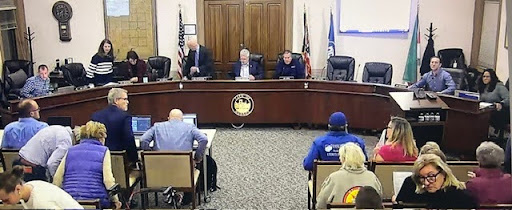
The council chamber was full, with residents prepared to speak out in opposition to the proposed settlement. The developer’s legal counsel, John Slagter, attended the meeting but did not address council during the public comments.
Caitlin Honniball, a Middleton Road resident, spoke again to council in regard to reported sewage backups at her property. The backups were attributed to a broken sewer pipe that Summit County — not the city of Hudson — was responsible for repairing. Honniball said city officials had not acted in good faith to assist her. She also said she felt intimidated during a meeting with city officials held the previous week and emphasized that residents seeking assistance should be able to expect greater support from city officials.
Kathy Russell presented a petition with 425 signatures in support of the city’s “adopt a spot” program and requested additional support and resources from the city to support and expand the program. The Hudson Heritage Association and Hudson Garden Club both support the expansion of the program.
Lois James, a former president of the Hudson Garden Club, expanded on Russell’s comments about the “adopt a spot” program by reading comments from Hudson residents expressing their appreciation for the program and requesting the city provide additional support for it.
A geologist with 40 years of experience addressed council on behalf of Lee Cosma, owner of the equestrian riding school on Ravenna Road across from the proposed Canterbury Meadows development. He presented utility plan maps provided by Prestige Builder and noted the following:
- The Prestige Builder Group acknowledged that the south side of the site is a low-lying wetland area.
- Preconstruction surface-elevation data indicated that the water table is very close to the surface.
- Once the existing retention ponds reach capacity, drainage could flow onto the equestrian-school property, which already experiences flooding to clay soil that does not absorb water.
- Retention pond #4 has no storage capacity and drains directly into wetland areas and the Cosma property. Retention pond #2 has an emergency overflow to the south side of Ravenna Street and onto the Cosma property and 30 feet of dense clay leaves no water infiltration capacity.
Greg Hall, a Ravenna Street resident, urged council to base its decision on the development of the Canterbury Meadows on data-driven evidence. He noted that the Ravenna Road area has documented flooding problems and may be unable to accommodate additional stormwater runoff.
Hall asked council to provide:
• Technical approval supporting the plan under consideration
• A study of the development’s historical impact on the community
• A site-specific analysis showing where stormwater would flow after the property is developed
• A financial risk analysis demonstrating that the proposed settlement would be less costly for the tax payers than litigation
• An ecological assessment of the effects on wildlife from converting the acreage to housing
Mayor explained that, under the Land Development Code, a conventional — or non-open-space-conservation — development in District 2 would be required to set aside 50% of the gross land area as private open space and provide a minimum lot size of 2.5 acres for each home.
Based on those requirements, he said the proposed 95-acre Canterbury Meadows development should include 18 homes rather than 32. He also stated that the proposal sets aside only the minimum 50% of the land as open space, rather than maximizing the amount preserved. The code asks developers to “create small tightly packed rural villages that maximize the amount of protected land,” Mayor said. Mayor asked council to renegotiate this settlement and go back to the agreement had when this was put into the LDC.
Kent Cleveland spoke out about the low-speed vehicle ordinance and asked for an allowance for these vehicles to travel on 35-mile-an hour streets for a limited period. Currently no such language is included in the proposed amendments to the ordinance.
Christine Thaxton, an AP Environmental Science teacher in the Hudson school system and a garlic grower at Thaxton Farm on Ravenna Street, described a meeting she had with city representatives the previous week.
Thaxton said she was informed that geotechnical work and stormwater studies would not be conducted until after the developer received approval to proceed. Although she was asked to “trust the process,” she said she did not believe the process had been followed with respect to the Land Development Code, the city charter, or coordination with the Planning Commission.
As a result, Thaxton said she lacked confidence that council would make the appropriate decision when considering approval of the development and urged them to vote no on the proposed settlement.
Kim Cosma Segedy, daughter of Lee Cosma, owner of the Hudson Equestrian Center, expressed concerns about the proposed Canterbury Meadows development adjacent to the property. She questioned why the city was proposing a settlement after prevailing in court — a concern she said she raised with the city manager and council member Weinstein when they visited to discuss the proposed development. Segedy said she was told that a settlement was necessary because of a hardship lawsuit filed against the city, although others had advised her that the suit would not hold up in court.
A Ravenna Street resident said the proposed development site has a long history of drainage problems. The resident noted that the land had previously been used for agricultural crops because of its existing drainage conditions. Given the established drainage patterns and persistent wetland conditions, the resident urged the city to require a detailed engineering review before approving the development.
Bill Klausman read a letter on behalf of a longtime Hudson resident who requested anonymity because of concerns about retaliation.
The writer questioned why council brought in outside counsel Michael Cicero during the Sept. 15 public hearing on the proposed settlement with Prestige Builder. Cicero stated on the record that the developer-plaintiff would prevail, and two outside planning consultants later supported that position. To the writer, their remarks appeared intended to make the plaintiff’s case and portray settlement as the only viable option.
The letter also cited the city’s earlier efforts to preserve its character by adopting a novel growth-management plan that it successfully defended against legal challenges from other developers. The writer concluded that the questions, statements and order of speakers at the Sept. 15 hearing suggested that council was unwilling to defend the decisions of the Planning Commission and Board of Zoning and Building Appeals in court. The letter ended: “In fact, if there were to be a trial, I would not be surprised to see some council members sitting behind the plaintiff’s table.”
Nova Buchanan expanded on comments she made to council at the Sept. 15 City Council meeting about her property, which is directly adjacent to the proposed Canterbury Meadows proposed development. Buchanan said her property already experiences standing water because of the high water table. She noted that the existing agricultural land relies on drainage tiles to manage excess water and warned that building homes on the site would worsen the existing drainage problems and asked council to reconsider the development of this land.
Anthony Revita once again addressed the council on his continuing issue and legal litigation with a fence he built on his property, per a granted city permit, that later the city determined infringed on the city right of way.
Council Comments
Goetz shared that she has recommended the architectural review board and Planning Commission get together to come to a resolution on approval on plans for townhomes. Weinstein thanked residents for their feedback on the settlement with Prestige Builder Group and said the concerns expressed will be taken seriously; that sentiment was echoed by White. Bird noted that early ballots had started and on the ballot is the city’s gas aggregation program. Anzevino read a letter into the record from Hudson Heritage asking for additional resources and support for “adopt a spot.”
City Manager Report
The Prospect bridge is to reopen on Oct. 23 and state Route 91 is to be completed end of November.
Consent Agenda
25-131: A resolution authorizing the city manager to advertise for bids and enter into contracts for the salt barn pad construction and relocation of existing salt storage foundation.
26-132: A resolution authorizing the city manager to bid and award for the printing services for the resident newsletter.
26-133: A resolution authorizing the city manager to advertise for bids and to enter into a contract with the lowest and best bidder for construction of the second phase of the fiber to home project and declaring an emergency.
Motion made to suspend third reading, and all consent agenda items passed on a vote of five in favor to zero.
Legislation
26-113: The ordinance amends Chapter 478 and addresses concerns raised prior to Ordinance No. 25-119 and new issues that have emerged after implementation. This is in regard to operation of a low-speed vehicle, under-speed vehicle, utility vehicle or mini truck. Third reading. Passed 5 to 0.
26-118: A resolution authorizing settlement of the Prestige Builder Group LLC versus the city of Hudson lawsuit and related claims. Third reading. Weinstein stated that there are inconsistencies in the land code that need to be addressed but that future changes do not apply to applications already in process. She then said additional time is needed to “understand the citizen’s concerns” and made a motion to postpone the vote until Nov. 17. The motion passed 5 in favor to 0 against.
26-124: This ordinance allows for the refinancing of existing financial obligations of the city. It allows for the rollover of note proceeds used to pay for the former Windstream property at 100 Owen Brown St. The project will be financed through the issuance and sale of $740,000 of taxable economic development nontax revenue bond anticipation notes for the purpose of paying costs for acquisition of 4 acres of real property. Second reading.
26-125: This ordinance allows for the financing of the former Windstream property at 94 Owen Brown St., 1 acre of real property, purchased as part of the Downtown Phase II Project, through the issuance and sale of $925,000 in bonds to allow for the rollover of note proceeds used to pay for the project. Second reading.
26-126: This ordinance allows for the refinancing of existing financial obligations of the city. It allows for the issuance and sale of not to exceed $6,825,000 of notes to finance the cost of the new bus garage and salt storage facility. Second reading.
26-127: This ordinance allows for the permanent financing of the construction of the new public works facility provided through the issuance and sale of bonds in the principal amount of $21,000,000 to pay for all costs of the public works facility. Second reading.
26-128: This ordinance authorizes the borrowing for the installation of the expected residential broadband services through the issuance and sale not to exceed $15,000,000 of notes in anticipation of the issuance of bonds for the purpose of paying costs of improving and expanding the city’s broadband. Second reading.
26-129: This ordinance allows for the financing of the remodeling/renovation of the fire/EMS through the issuance and sale of not to exceed $5,000,000 of notes in anticipation of the issuance of bonds for the paying of the costs of the project. Second reading.
26-130: This ordinance authorizes the city to borrow up to $3,000,000 through the issuance and sale of notes to fund the installation of automated metering infrastructure (AMI) for the water and electric departments. Capabilities of the AMI system will enable the continuous, two-way exchange of real-time usage data between the utility billing system and utility customers. Second reading.
The meeting was adjourned at 9:20 p.m.
Post a reply