Documenters: Hudson City Council meeting Sept. 15, 2026
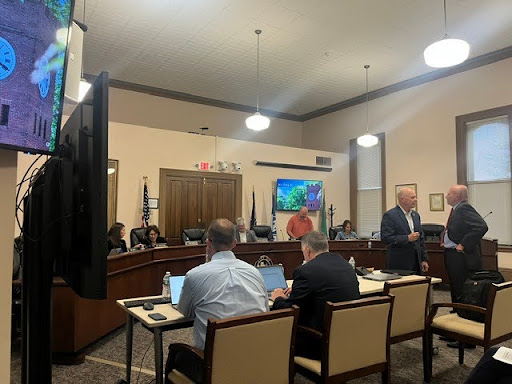
By Julie Erickson
Attendees
Jeffrey Anzevino — Mayor
Michael Bird — President of Council, Ward 4
Kyle Brezovec — Council Member, At-Large
Samantha D’Eramo — Council Member, At-Large
Patricia Goetz — Council Member, Ward 1
Skylar Sutton — Council Member, Ward 3
Amanda Weinstein — Council Member, At-Large
Dan White — Council Member, Ward 2
Call to Order
The meeting was called to order at 7:30 p.m. with all council members present. Council then recited the Pledge of Allegiance, followed by roll call.
Approval of Minutes
The following meeting minutes were approved as presented:
- Aug. 10, 2026, Council-PC joint meeting on Clinton Crossing
- Sept. 1, 2026, meeting
- Sept. 8, 2026, workshop meeting
Honorary Resolutions
The mayor read a proclamation recognizing the 2026 Mighty Vincent Project for its service to the community and its efforts to raise awareness for those in need. The proclamation designated Sept 19-27, 2026, as Mighty Vincent Project Week.
The mayor read a proclamation recognizing the 2026 Mighty Vincent Project for its service to the community and its efforts to raise awareness for those in need. The proclamation designated Sept 19-27, 2026, as Mighty Vincent Project Week.
Anzevino recognized Jacob Meacham, an elementary school student who calmly assisted an injured friend during an emergency. In addition to the proclamation, the mayor presented Meacham with the mayor’s limited-edition coin.
The mayor also recognized the Hudson Kiwanis Club on its 75th anniversary. He acknowledged the club’s advocacy for children and families in Hudson through its community service projects that promote learning and its leadership providing scholarships, youth programs and community events.
The mayor proclaimed Sept. 17-23, 2026, as Constitution Week in Hudson. The mayor urged all citizens to study the constitution in honor of this week. A traveling Revolutionary War exhibit will be on display, Oct. 4-17 at the Cuyahoga Falls Library.
Public Legislative Hearing
Resolution 26-118 would authorize a settlement between Prestige Builder Group, LLC and the city of Hudson related to litigation and claims concerning the Canterbury Meadows development. This is a second reading with the final vote to be taken at the Oct. 6, 2026, scheduled city council meeting.
The property includes 95.56 acres of residential and rural agricultural land along Ravenna Road and Stow Road. Under the proposed settlement, the pending lawsuit — including a multi-million-dollar hardship claim — would be resolved, and the site would be developed as a single-family open space conservation subdivision.
City review bodies — including the Planning Commission, the Board of Zoning and Building Appeals and City Council — previously denied or blocked the proposed development. Prestige Builders in 2023 then sued the city of Hudson in Summit County Common Pleas Court. The developer lost in that court and later.
The city of Hudson has reached a tentative, court-mediated settlement with Prestige Builder Group, which would authorize the city manager to execute the final agreement on behalf of the city. City approval of the settlement would end further litigation expenses, reduce financial risk and expand the city’s tax base.
Before opening the public hearing for citizen comments, the mayor outlined the order of presentations. The hearing would begin with introductory remarks from the city’s outside counsel, Michael Cicero. Cicero also serves as counsel for NORMA, the Northern Ohio Risk Management Association. Those remarks would then be followed by a presentation from Sarah Kelly and Delaney Sillman of Planning NEXT, the independent zoning consultant retained by the city of Hudson. Their review focused on whether the proposed replacement development plan meets or exceeds the requirements of the city’s land development code and how it aligns with Hudson’s 2024 Comprehensive Plan.
Residents who live within 300 feet of the proposed development were to be given priority to speak and allowed to speak for 15 minutes. All other residents were given the standard 5 minutes. All speakers were sworn in prior to giving testimony.
Cicero was asked by NORMA to review the proposed settlement for compliance with Hudson’s existing land development code. NORMA is the insurance pool that a number of municipalities fund to cover claims lodged against the city.
Cicero became involved because Hudson’s code includes a separate process for administrative review of constitutional claims, and the developer has asserted such a claim. Because constitutional claims can precede federal litigation, the city asked Cicero to review the related constitutional issues. Cicero then reached out to Planning NEXT in Columbus, which was then retained by the city to do an analysis of the proposed development’s compliance to Hudson land development code.
Planning NEXT presented its compliance review of the proposed conservation subdivision development under the city’s land development code, which found that the plan did comply. Planning NEXT also concluded that the open space conservation subdivision fits within the common definition, requirements and ordinances for a conservation subdivision. In addition, the firm found that the open space conservation subdivision standards would produce a better design than what is allowed under the city’s current code.
Cicero and Planning NEXT were then called up to clarify comments made and answer questions from council members prior to allowing citizens to make their comments.
After recusing himself, Council Member Sutton was the first resident to provide public comment and was accompanied by his attorney, Mark Stockton. Sutton stated that the settlement agreement violates multiple Ohio state and local laws. He questioned whether council has the authority to approve the agreement and whether doing so would conflict with council members’ oath to uphold the Ohio Revised Code, the Hudson charter and Hudson’s codified ordinances. Sutton cited several ordinance provisions, including Codified Ordinance 1202.0282. He said that provision gives the Planning Commission sole authority to take final action on proposed preliminary and final subdivision applications. He summarized his position by stating, “you cannot contract around the law.”
Sutton also objected to section 6 of the settlement agreement. He said the section would allow the city manager to approve modifications to the development plan without public oversight. In his view, the plan presented at the meeting would not necessarily be the plan ultimately implemented and could be changed without additional public review. Sutton said the settlement was being presented as a resolution of a hardship claim and explained why he believed it did not meet that standard. He summarized his position by stating that the settlement is not compliant with the city charter, codified ordinances or state law. At a minimum, he said it violates City Ordinance Nos. 20610, 12022, 12027, 12033, 120310, 12045 and 12076; the entirety of Chapter 1210; Ohio Revised Code 713.03; and City Charter Section 902.
Sutton closed by saying he hoped council would recognize what he viewed as flaws in the settlement and vote against it. If council did not do so, he said he would seek relief through the court system.
Melissa Jones, a resident whose property is adjacent to the proposed development, spoke next. She was accompanied by her attorney, Stockton. Jones stated that she submitted an expedited public records request to the city on Sept. 3, 2026. She said she received confirmation on Sept. 4 that the request had been received, but as of the meeting date, the requested documents had not yet been provided. She said the lack of access to those documents limited her ability to fully testify that evening.
Jones described the settlement as an “end run around the final judgment of the Summit County Court of Common Pleas.” She also said council does not have the authority to grant approvals that the Planning Commission denied and that the Court of Common Pleas upheld.
Jones raised concerns that the settlement language could allow the proposed development plan to be changed at any time with only the city manager’s approval. She said that process would not comply with the city charter’s requirement for Planning Commission review. Jones stated that the settlement is illegal, represents a poor resolution and sets a dangerous precedent on multiple levels. She asked council to do better.
Kim Cosma Segedy, owner of the Hudson Equestrian Center across from the proposed development, expressed concern about stormwater runoff from the project and its potential impact on her property. Brezovec asked City Manager Thomas Sheridan whether a stormwater impact study had been completed. Sheridan replied that no study had been conducted because the plan is currently only conceptual.
Nova Buchanan, who lives behind proposed lots 21 and 22, expressed concern that the development could place a trail or access way along her property instead of a neighboring home. Buchanan said her primary concern is the additional traffic the development could create on Stow Road and went on to say that because the hearing concerns a hardship settlement review, the process may limit public input on the actual development plan that would be implemented for the property.
Jennifer Kellerman, who lives 400 feet from the property, expressed her concern with the increase in traffic this project would contribute and said that a traffic study needs to be done for this project.
Mary Miller echoed concerns regarding water run-off from this project and is concerned that under this settlement, the city manager could make the decision on the development plan without zoning and Planning Commission approval.
Susan Newman spoke on behalf of the Hudson Heritage Association and said the proposed settlement conflicts with the city’s current comprehensive plan. Newman stated that council has continued to downplay the importance of the comprehensive plan, even though the city charter gives it significance. She also said the proposed settlement would undermine the Planning Commission’s authority by giving the city manager final approval over the development plan under the settlement agreement.
Christine Dicato Thaxton, owner of Thaxton Organic Farm, stated that she believes the proposed development does not comply with the city’s rural residential codes and expressed concerns around the soil and groundwater on this property to be developed.
Phil Leiter noted that the settlement references the 2014 comprehensive plan, not the 2024 comprehensive plan that seeks less density in development. Leiter said he views this settlement as politically motivated, though he does not believe this is due to the campaign donations the developer made to three sitting council members.
Greg Hall, a structural engineer and former secretary of the 2025 Charter Review Council, asked council to reject the settlement, stating that he does not view the matter as a hardship case. Hall said the hearing appeared to focus on whether Hudson would accept the development under the terms of the settlement, rather than on whether a hardship claim had been established. Hall noted that the Planning NEXT representatives had left earlier and were no longer present, despite having been retained by the city for their expertise. He said he believed they missed the broader context behind the District 2 and rural residential designations, including the city’s goal of preserving a diverse landscape. Hall acknowledged that Planning NEXT may have found in their opinion that the proposal meets the legal definition for low-density areas. However, he said the firm missed the purpose behind why the city established those designations in the first place.
Sarah Norman, planning commission member, addressed the fact that Planning NEXT representatives had given a high-level review of the project to council, but unlike the Planning Commission, did not dig into the details. If those Planning NEXT representatives had remained for the entirety of the meeting, they would have been asked how they saw a small village feel from this plan as it is lacking details; they missed that open spaces are required in all city developments. Planning NEXT did not state they reviewed sworn testimony of residents regarding issues with current storm water run-off on this property, which in the original plan, the water was directed onto surrounding property. Norman said there are many questions that need to be answered and that this hearing should not be closed.
D’Eramo agreed that many questions are yet to be answered and need to be answered. Bird cited an ethics code and stated under ethics law, Weinstein, D’Eramo and Brezovec do not need to recuse themselves from a vote on this resolution. Weinstein and Brezovec both reiterated that the campaign donations would not affect their vote and had sought out legal review to ensure they complied with ethics code.
The developer’s legal counsel, John Slagter, spoke next and reviewed the history of the litigation. He explained that his client filed the legal actions to protect what he described as constitutionally protected rights and that if his client is unable to proceed with development of the property, those rights would be violated. Slagter advised council to rely on the separate independent consultants hired by the city, rather than on residents who live next to the proposed development. He later clarified his comment that of course council had to listen to residents and he felt they had been heard by council and by the developer.
Council members then questioned Slagter. Weinstein asked whether he believed council had the authority to approve the proposed settlement. Slagter replied that, based on his review, council did have that authority.
The hearing then closed and the council moved to the regular agenda.
Resident Caitlin Hannibal addressed council on her issue of having raw sewage in her home three times and what she felt was a lack of response from council and the city.
Resident Jones briefly responded to comments made by Slagter. She explained that she lives on property adjacent to the proposed development and also serves as a Planning Commission member. Jones said she was concerned by Slagter’s remarks and wanted to clarify her role in the matter as both a private citizen and committee member. To avoid any conflict of interest, she recused herself from Planning Commission discussions about the development. She said she was later advised in writing that she could still participate and comment as a private citizen whose property is adjacent to the development.
Anthony Revita addressed council on his ongoing litigation regarding right of way infringement of a fence he constructed on his property.
Brezovec provided updates on two items:
- The city’s broadband initiative timeline is being revised.
- The women firefighters’ locker room is now in place.
Weinstein reported that she attended an environmental awareness meeting and a Planning Commission meeting. She stated that the Planning Commission requested a six-month moratorium on all planned developments while it considers changes to the land development code. The Planning Commission also approved a new daycare center and the construction of townhomes at Clinton Crossing. Goetz stated that the Architectural Review Board later did not approve the townhomes approved by the Planning Commission, so this is yet to go forward.
The mayor addressed concerns raised by Hannibal and stated that the city does care about her situation. He said the matter had been discussed with her, but explained that the sanitary sewers are not owned by the city but owned and maintained by Summit County and, therefore, the city cannot work on or maintain them.
There were 150 spots available for the city snow plowing program with applications accepted until Sept. 4. The splash pad closes at the end of September.
A motion was taken and passed to extend the meeting past 11 p.m.
Consent agenda
All listed items on the consent agenda passed with rules suspended to pass on first reading.
- 26-78: An ordinance to amend chapter 876 short-term rental operations. Third reading will be Oct. 6.
- 26-118: A resolution authorizing settlement of the Prestige Builder Group LLC versus the city of Hudson lawsuit and related claims. Second reading, with third reading Oct. 6.
- 26-124: This ordinance allows for the refinancing of existing financial obligations of the city. It allows for the rollover of note proceeds used to pay for the former Windstream property at 100 Owen Brown St., purchased as part of the Downtown Phase II project. First reading.
- 26-125: This ordinance allows for the financing of the former Windstream property at 94 Owen Brown St., purchased as part of the Downtown Phase II project. First reading.
- 26-126: This ordinance allows for the refinancing of existing financial obligations of the city. It allows for the sale of notes to finance the cost of the new bus garage and salt storage facility. First reading.
- 26-127: This ordinance allows for the permanent financing of the construction of the new public works facility. First reading.
- 26-128: This ordinance authorizes the borrowing for the installation of the expected residential broadband services. First reading.
- 26-129: This ordinance allows for the financing of the remodeling/renovation of the fire EMS. First reading.
- 26-130: This ordinance authorizes borrowing for the installation of the automated metering infrastructure for the water and electric departments. This system enables continuous, two-way transfer of real-time usage data between utility billing and utility customers. First reading.
The meeting was adjourned at 11:30 p.m. with an executive session to follow.
Post a reply