Documenters: Stow Board of Education meeting for July 1, 2026
By Noell Wolfgram Evans
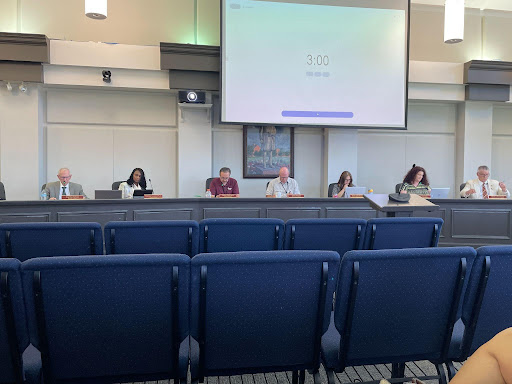
The Stow-Munroe Falls Board of Education held its regular July meeting at Stow City Hall. In attendance were Board President Jason Whitacre, Board Vice President John Moyer and Board Members Tina Merlitti, Kari Suhadolnik and Mike Sheehan. Also attending were Superintendent Felisha Gould and Interim Treasurer Ira Hamman.
Whitacre called the meeting to order at 7 p.m. with the standard opening business: roll call, the Pledge of Allegiance and a reading of the statement of purpose and expectations. Whitacre then asked for approval of the night’s agenda. Sheehan read a prepared statement on his goals and approach to meetings and then made a motion to amend the agenda by adding two items to it. There was no second and the agenda was adopted as proposed.
Members of the public were then invited to speak. Evelyn Kremyar encouraged the board not to join the National School Board Leadership Council, which she alleged was a right-wing organization whose “vision is not aligned with our students.” She also called “ridiculous” a proposed “Lame Duck Exchange” for board members that would be up for discussion later in the meeting.
Marty Simpkins was concerned that the board would be approving three-year contracts for administration members “with a levy coming up that we all know probably won’t pass.” She also had concerns with the proposal for a contract for Xerox, saying “you guys need to learn how to make some changes.”
With no other community members rising to speak, the board took on the superintendent's consent agenda, which contained only two items. The first was for the approval of Stow Police to carry firearms on school property when off-duty and the second was the acceptance of gifts. Both were approved unanimously.
Discussion then moved into the superintendent’s recommendations for personnel and contracts. Sheehan said he was glad that everything worked out for the cheerleading position and hoped that they would have the full support of the administration and school because “this seems to be a year-in/year-out problem.”
Sheehan next asked for clarity regarding the hiring of a facility manager. He stated that he thought they just approved someone for this position and wondered why the district needed two people in this role. Gould explained that the person in the role resigned because they had recently been married. She also explained that the contract was for one person, but it (the contract) was split up between fall and spring.
“I can speak to the financial insecurity we may be facing, so I don’t want to support any three-year contract when we might have to be making some hard decisions,” Sheehan said.
This prompted a broader discussion on how contract length might affect across-the-board pay cuts or reduction-in-force decisions. Sheehan then made a motion to separate individual personnel items out of the consent agenda. There was no second and the personnel recommendations were put up for a vote. Sheehan voted no, but all other board members voted in the affirmative and the recommendations were adopted.
The board next considered Brian Falhamer as principal at Woodland Elementary. Sheehan said that to be consistent, he would prefer considering a one-year contract over the three-year one before the board.
“We’ve already had that conversation,” Whitacre said, and then called for a vote.
Sheehan voted no, but all other board members voted in the affirmative.
Several contracts were then brought before the board. The first was for translation services provided by Cross Thread. Sheehan questioned how many children received this service. Gould replied that 125 used it, but that the district was monitoring 96 others for potential inclusion.
“How many years do students typically use this service?” Sheehan asked.
Gould did not know.
“Again, to be consistent, I’m against a three and would prefer a one,” Sheehan said.
He then asked if all of the students using the service were U.S. citizens.
“I’m not sure what you’re asking,” Gould replied.
Whitacre followed up, saying “I don’t think we need that in there.”
A vote was then taken with all members, except Sheehan, voting to approve the contract.
A contract for LLA Therapy services was next for consideration. Sheehan asked how long the contract was, how many people used the service and what was spent last year. Gould did not have those numbers at the ready and suggested that Sheehan send her the questions in advance of the meeting next time.
Suhadolnik then spoke up to ask Sheehan: “Do you really want the answers or do you just want to be able to ask the questions?”
Merlitti wondered if this was a service that was required by law. Gould quickly answered yes. Discussion was held over who pays for the service (the federal government) and how vendors are selected. Finally, the entire board voted to approve the contract.
Service agreements to enable five students to use Wings of Change was the next item up. After a similar line of who and how many questions from Sheehan, the entire board voted to approve the agreements.
Sheehan also had cost questions about the contract for LearnWell, but eventually voted with the rest of the board to approve the service contract. Contracts for Asian Services in Action and ESC of Medina County were also unanimously approved.
Mark Treen, director of operations, led the discussion on the next agenda items. First was a contract for ParentSquare, which he called “critical to our communications with our parents.” Sheehan asked why a service was needed and why the district couldn’t just use email and text.
“This is our email and texts,” Gould responded.
A discussion over costs and use was had, with Sheehan making a motion that the terms of the contract be changed from three years to one. Whitacre asked Treen what the cost ramifications of doing this would be. Treen explained that the district was receiving a discount for the longer term. All board members then voted in the affirmative for the contract, with Sheehan couching his vote by saying “it goes against my better judgement."
Treen next asked for approval for a contract extension with Tyler Technologies for bus tracking services.
“This will be helpful, especially with the bridge being out,” Whitacre said.
The board approved the contract unanimously.
A contract with Xerox for the district's copiers, printers and toner was then considered. Treen said this contract should gain the district an average of $8,000 in savings year in and year out. With this detail, the board approved the five-year contract. They also approved a contract with Finalsite for work on the district website, including getting it into ADA compliance. Contracts for other technical services from Pro-Team and Verkada were also unanimously approved.
As the board approved it, Treen shared that the contract before the board with Love Insurance did not reflect a rate change or increase in baseline costs.
Three bids for asphalt work within the district had been reviewed by Treen’s team, and it was decided to bring the bid from Cardinal Asphalt before the board. The bid, in the amount of $58,000, “isn’t making our parking lots perfect, but it is helping us meet our insurance obligation,” Treen said. The members of the board unanimously approved that contract, along with one for emergency repairs to the elevator at Kimpton. Sheehan wondered if there was not a service agreement in place and, if so, why this issue wasn’t caught sooner. Treen explained it was caught during a routine service call.
A gifted services plan was next put before the board. Merletti abstained from the vote but every other member voted in the affirmative. The final item in the superintendent’s recommendations was a memorandum of understanding with the teachers union regarding the role of athletic secretary. There was much discussion on the timing of this memo, how the work was being done before it was put into place, and what the amount of back pay in question amounted to ($700). Finally, all members voted to approve the memo.
The board then moved to the treasurer’s consent agenda. Before voting, Sheehan had questions related to the minutes of the June meeting. In that meeting, he asked about the start date of the district’s PR person and Gould told him December. He said he looked the information up later and found it to be May, so he questioned why Gould told him differently.
“Because maybe I forgot the month,” Gould said. Gould then asked why the start date mattered specifically and Sheehan said it was due to issues he was seeing on the website.
Sheehan also had questions on the timing of the AI policy that the board saw in the June meeting. Whitacre interrupted the discussion to remind the board that the question before them was simply if there are issues with the meeting minutes.
“Yes there is,” Sheehan replied.
Moyer suggested that the questions be taken to the individuals outside of the meeting. Sheehan said he disagreed because they were board discussions, so they should be considered in a board meeting. Suhadolnik then moved to call the question and Merlitti seconded it. Sheehan voted no, but all other members of the board voted aye.
The next item up was a recommendation by the treasurer to enter into a contract for services with BoardDocs for the upcoming school year. Whitacre said that the site has been unreliable at times and questioned as to if there are any alternatives to it. Hamman did not know. Whitacre voted against the contract, but all other members voted for it.
Hamman then presented a resolution of necessity for an emergency levy renewal. He said that the levy currently in place, which expires in December, means that the board can put a new levy on the ballot, but it will need to be in the same amount and for the same amount of time as the existing levy. This resolution would allow the district to go to the county moving forward with that process. The entire board approved this resolution.
A motion for appropriations for 2026-2027 was put before the board. This allows Hamman to continue to pay bills until the final appropriation comes before the board in September. Sheehan questioned why there was no allocation for the turf improvement fund. Hamman explained that the only things showing in this motion were for expenditures. As part of his explanation, he pulled out the full report and walked through where things can be found within it. Sheehan continued asking for category definitions, which Hamman offered up. As this continued, Gould offered a breakdown of the fundraising categories and shared some details on how these funds are dispersed. Following this discussion, all board members voted to approve the motion. They also approved the lists of advances and transfers presented and a change in the classification of the assistant treasurer to an administrator role.
The board also approved a change to the day rate of the interim treasurer.
Whitacre next discussed possible student board representatives and Ella Dunmire was selected for the position. Sheehan then offered thoughts on the role in general and suggestions that the student rep be appointed by the Student Council and have a mentor on the board.
Suhadolnik refuted many of Sheehan’s points, calling them "disingenuous" and “fabricated.” Merlitti said “having a student representative has been very helpful to me.” Whitacre agreed that there’s always room for growth. A vote was then taken for the appointment with all members, except Sheehan, voting yes.
Sheehan then spoke on proposed changes to three district policies. He started by making a motion that the board ask the superintendent to review policy 0154 for “duplication with existing policies.” Whitacre said that the items in question were part of the revised code and the policy was only intended to point to the code. This opened a discussion as to the structure of the need for the policy and the wording of the language within.
Much of the discussion centered on one word: “may.” Sheehan believed that without a change, the board could be accused of viewpoint discrimination. Suhadolnik was worried that changing the language could open the board up to becoming more political, and Whitacre clarified that he is not saying he’s looking for the board to join any organization, but that some change could be considered. Sheehan made the motion for a change, but Whitacre said that a motion isn’t needed as this would be considered a first reading.
With that, Sheehan moved on to his second proposed policy change, which he said was developed in conjunction with NSBLC: a lame duck policy extension. The change would deal with contracts that are approved by a board after an election and before the newly elected board is seated. After some discussion, Sheehan tore the proposed change up and said any new board could just repeal the contract.
Still, Suhadolnik made a motion to remove any policy from consideration that was made with the support of the NSBLC. Merlitti seconded it.
“You can’t do that,” Sheehan said. “Are you inhibiting my free speech?”
“I want to make sure I understand the motion,” Whitacre said.
Sheehan jumped in and said, “yeah, let’s go ahead. Let’s pass that. Any attorneys out there watching this, get a load of this one.”
This opened some discussion on what organizations the board can take policy recommendations from. A vote was made on the motion with Suhadolnik offering the only affirmative vote.
The next discussion was around how individual board members can access and spend a service fund. There was some question over how this is established, how much is allocated and how it can be spent. Whitacre said, about Sheehan’s proposal regarding this, that he was “uncomfortable giving myself or any other board member unilateral authority over the fund.” Merlitti asked for clarification about “spending $4,000 of the taxpayers’ money.” The response from Sheehan was that he just wanted board members to be able to join organizations that they felt would help them become effective leaders.
Whitacre offered to make the proposed adjustments to the policies, as discussed, for second reading at the next meeting.
Sheehan asked Whitacre if he could address some questions to the superintendent and treasurer, but Whitacre said there wasn’t space on the agenda for questions outside of the evening's topics. Sheehan said he wanted to propose space in the agenda for just that. Moyer said an email or phone call might reach the same point.
Whitacre invited the public to make any final comments, and Simpkins returned to the podium. She wanted to point out the number of admin cell phones, legal fees, PR, trailers and other expenses. She called out what she said was a drop in enrollment across the district and questioned the spending versus the true need for a levy.
Rachel Jamison then rose to speak. She was concerned about the service fund for the board and its potential use to support the NSBLC.
After 3+ hours, the board meeting was adjourned.
Post a reply