Documenters: Stow-Munroe Falls Board of Education meeting for March 30, 2026
By Noell Wolfgram Evans
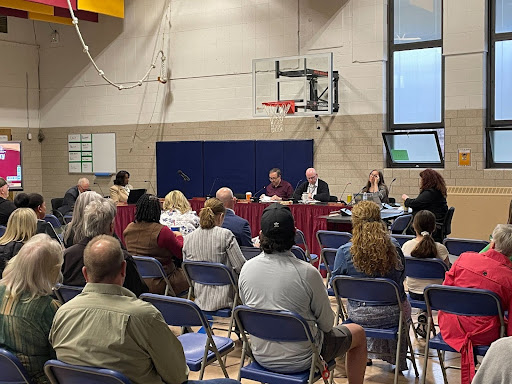
The Stow-Munroe Falls Board of Education held its March meeting at Fishcreek Elementary School on March 30. The meeting was called to order at 6 p.m. with the Pledge of Allegiance and roll call.
In attendance were Board President Jason Whitacre, Board Vice President John Moyer and Board Members Tina Merlitti and Kari Suhadolnik. Board Member Mike Sheehan had an excused absence. Also attending were Superintendent Felisha Gould and Interim Treasurer Ira Hamman.
After a unanimous approval of the evening's agenda, Whitacre invited Catrina Burwell, principal of Fishcreek Elementary, to provide an update on the school. Burwell said the school had recently received a 3.5-star rating.
“It’s good, but we’re not happy with it,” she said. “We think we are a five-star school.”
She then proceeded to lay out a plan that included improving math scores, better communication and student and staff development that she hoped would improve that rating.
Burwell shared a number of recent happenings at the school, including having Kent State student-athletes come by, before turning the microphone over to Andrea Brown, the advisor for student council. Joining her were members of student council, who each took a turn sharing what they love about Fishcreek. As their presentation ended in applause from the nearly full auditorium, Gould thanked everyone for the great effort happening at the school. She then transitioned into a presentation to celebrate the March Center Stage winners. A collection of 11 employees from across the district, including teachers, a principal, maintenance team members, a bus driver and staff members, were all individually recognized for what Gould called “an effort that went above and beyond.”
As the honorees settled back into their seats, Whitacre shared a video of the high school band, which was marching that week at Disney.
The next item on the agenda was a draft of the proposed Five-Year Strategic Plan for the district. The plan was created by Doreen Osmun and Phil Herman of The Impact Group. Before unveiling the plan, Herman reminded the board of the work the district has collectively done to this point. Included in that were a number of meetings, surveys and discussions where the district's strengths and weaknesses were discussed.
He said some of the most common points of strength included “the amazing opportunities we offer through the arts, our elective offerings and the CCP, AP and CTE programs.”
“There was great praise and recognition of the commitment here to the support and services available for a student’s mental health,” Osmun said. “There is a lot being done, but we’re not done yet.”
When it came to concerns, Herman said that unfunded mandates and facilities and infrastructure needs were consistent themes. With that, they unveiled a six-point plan with individual objectives under each point. Herman reiterated that this was a draft proposal and it would need to be reviewed, discussed and refined. He said the goal was to have a plan approved by the board and in place by Aug. 1.
Following the presentation, the board had several questions about the substance of the information and the process going forward. Whitacre was concerned about language citing the use of AI, while Moyer wanted to know if there was a matrix in place that connected the goals and sub-goals so they could understand the relationships. Herman said all of those things could be worked on.
“Ultimately, we want to make sure that the words are reflective of where we want to end up," he said.
Following the presentation, the public was invited to come forward and make comments on agenda items. Marty Simpkins questioned why the board was spending $40,000 on a survey and potentially another $40,000 on a plan when they need money for the track.
Evelyn Kremyar asked the board to explain during its review period some of the proposed policy changes and how they pertained to RTRI. She also expressed concerns about LifeWise Academy and its involvement in RTRI at the school.
With no other residents wishing to speak, the board took up the superintendent's consent agenda. This included the approval for the acceptance of a $30,000 gift from the Lozick Foundation for the STEM program and a gift of $10,000 from the IMPE Club, also for STEM. They also approved 10 additional community donations of goods and services.
Next the board unanimously approved several contracts for new computers, electric work, to enter into an education consortium for energy rates and to work with the Ohio Schools Council to assist with bidding on a new bus.
Whitacre abstained from the vote allowing the band to have a summer band camp, but all other members voted in the affirmative.
The portion of the superintendent’s consent agenda that created the most conversation was the request to enter into an agreement with Satchel Pulse for student surveys. Merlitti questioned how the surveys were administered, while Moyer wondered if the information was shared with parents. Whitacre had concerns with the data privacy policy of the company, which led him to ultimately vote against the contract. All of the other members voted to approve it.
Hamman was up next, and he provided a brief treasurer’s report. He said that in February, revenue over spending was positive, and he attributed that to the annual influx of tax payments from the state.
He also asked the board to approve a continuation of the contract with Rea and Associates. They are helping the district get their 2024, 2025 and 2026 fiscal years closed out with the state auditor. Moyer asked if there was not a way to do that internally. Hamman explained that they did not have the people and time to do so. Whitacre asked if it was normal for a district to be this far behind in terms of closing out fiscal years. Hamman said no and added that the state was being understanding as they tried to get caught up. The board approved the contract unanimously.
Next up were first readings of proposed policy changes to district policies 1422, 3122 and 4122, as well as food services policy 8500. There was also a second reading of 5223, which would permit students to be excused for RTRI. Suhadolnik asked Gould for clarification on what types of instruction could be missed.
“They are our content area courses,” Gould said. “They do not include the exploratory courses there.”
She also said that when they spoke with LifeWise, the organization said they would be looking at doing something during lunch periods.
The board then moved into executive session to discuss employment issues.
Post a reply